Wednesday, 6 June 2012

The hidden village - a great menue!

About two weeks ago Claudia, Yuki and Yoshida-san went with me into the hills of the northern part of the province Okayama. Yoshida-san is a collogue of my professor and is in charge to drill and maintain our wells we use for our experiments. Since we asked him, whether he would know a good place where we can purchase cheap fruits and vegetables, he offered us to give us a lift into the hills where many farms are located. 
Our first stop was in a random village close to the airport of Okayama. We discovered a vineyard so different from those I have seen in Europe or Australia: they were mostly in glass houses and ONE single plant is just huge compared to the wine in Europe. We asked a farmer for direction and he invited us into his glass houses:


Yuki in front of the vineyard glass house.

A single wine plant!
Yoshida-san drove his little mint-green Nissan March further up and into the hills. After a 30 minutes drive he suddenly stopped in a curve and turned sharp to the right to drive up a rather tiny road with a extremely steep slope.

little road to the village.
We would normally have definitely passed by this road - it honestly looked like it will end in a dead end but we were pretty amazed that at the top we discovered a village where we only met people of age 60+. Our target was a organic restaurant that is lead by an old couple. The husband is called Shinichirou (新一郎) and his wife  好美. While Shinichirou was preparing the food his wife showed us the huge garden they manage  together and that only five days of the week. It was great fun to taste all the different herbs and strawberries they grow and also learn about the Japanese names of the plants, even though I've already forgotten them (or let's say: I can't recall them - they are probably still somewhere burried in my brain). Yoshida-san was in the mean timing enjoying him self in the little garden house.

View from parking spot down to the village.

One of the green houses

Part of the garden


Yoshida-san
Shintarou told us that he is already older than 70 which we could hardly believe. He was so energetic and jumped around, always smiling. He brought us an old map book (more than 20 years old) where he kindly asked us to sign on the page where Germany was printed on and mark the lace on the map where we are from. So Claudia and I marked Dresden and a little village in Thüringen.


The map

The meals were just stunning delicious! We first got served fresh, slightly salty butter with still warm fresh tiny gold brown rolls. Next came a ham salad on fresh garden vegetables, followed by a simple but rather delicious onion soup with a perfect amount of crème in it. The main dish was roasted chicken with beans, carrot and a bitter leaf. As climax brought Shinichiro at the right moment, when we were just half done with our main dish, fried potatoes (still with skin - yes Oma, still with its skin - I told you that this is the best way to eat it) and baked with cheese (I think it was Gauda). While we enjoyed the various dishes, both of them were explaining the things we ate just in that moment: where they grow it, what it needs, which nutrients it has and so on, all outside in a garden on top of a hill somewhere in Okayama.

Butter with fresh rolls

Ham salad

Onion soup

main dish: roasted chicken

climax: cheese potatoes

Yoshida-san and Yuki
Fortunately, I didn't  forget to take pictures of the amazing herbal tea we got served with a final salad and lemon sorbet cake which was definitely one of the best cakes I ever had (and so far I can only remember one cake in Regensburg about 8 years ago which may rank in the same league).

final salad

Epilogue cake!
We said farewell and "hope to see you again! We certainly will come back!" to both of them before Yoshida-san decided to takes us to a small bakery, in a tiny village and the edge of a forest. By the way, the whole menu we ate costed about 4.800 Yen per person.


Saying farewell!
To reach the bakery we drove about one hour back to Okayama. Claudia and I fell several times asleep while Yuki at the front seat forced himself to stay awake and talk to Yoshida-san. We got lost and needed to consult my GPS to find the way to the bakery. The shop was pretty small: a natural women in terms of not wearing any make up in probably her 30th sold us some self made bread, which was a bit hard, but since Yoshida-san paid for eat there was no way to complain about it. The best thing was that I drank so much herbal tea at the restaurant that really needed to go to the toilet. I asked the shop woman if I could use the toilet in her house and she showed me where her compost toilet was. Her husband worked at a close-by field and her about 5 years old daughter played in front of the house. The toilet was amazing and I couldn't help but taking a picture of it. I'm terrible sorry that I'm going to show you a picture of a toilet after all the good food, but life lives from contrasts, isn't it?


Entrance to the bakery

Compost toilet d(^.^)

Recycling paper backs!!! d(^.^)

Awesome spider close to the toilet


All in all we had a really great day thanks to Yoshida-san and I really want to thank him for this. I hope to go back to the restaurant in July/August with two great friends who are going to visit me.

Saturday, 26 May 2012

Solar Eclipse in Japan

This week Monday a solar eclipse traveled through and reached it's maximum at about 7.30 am in Okayama. I had a beautiful accompanied breakfast while watching the eclipse through my camera. I didn't buy those special glasses, since they were quite expensive and used my camera instead as you can see in the picture at the bottom.
The last time I saw one was about 2002 or 2004 in Germany, I can't quite remember well and it was not a total eclipse. This time I was also just a bit out of the inner core shadow but the morning darkness the shadow casted was quite impressive. The light was rather dull and the birds that were singing a couple of minutes before stopped there morning song.

Solar Eclipse over Japan seen from Okayama.

Dream of some green

I remember quite well how shocked I was when I first saw the city architecture of Osaka and later Okayama. Narrow streets, blueish greyish colours and supply lines such as electricity and telephone just above the street. It took me a while to understand and accept why a Japanese city looks like that, so different from cities I'm used to.  But not every place looks like the other - for instance was I positively surprised when I first came to Tokyo and expected to see a busy tree less city, but rather found a green organised town.

First of all Japan suffers from natural disasters, unlike Germany. Since there are regular earthquakes and Tsunamis in most parts of Japan to put things under ground just makes no sense - if they get damaged you need to repair them and when they are underground it will just cost you too much money and effort. To put things above surface is just more handy and convenient in case something brakes - convenient. 
The greyish colour comes from the - in my opinion - most common used material in Japan: concrete. I still try to figure out why architects in Japan seem to be so obsessed with concrete, because even my friends don't agree to the statement that concrete is beautiful (sorry Andy).  One explanation I try to come up with (but still need to confirm) is that public income for a city is much lower than for instance a "general" German city, due to lower tax incomes. In Japan everything is taxed by just five percent. This may lead to a cheaper and just convenient why of constructing things - in concrete.
One last point is that there is just no space in Japan because everyone gathers at the coastal area. Houses, streets and walk ways are just much narrow than most European facilities. 

But even when houses in the city are not surrounded by a back and front yard, Japanese (or at least they give me the impression) want and enjoy a bit of nature and greenery around them. Of course most people enjoy parks and temple areas which are exceptional beautiful, green and recreative.

Temple in West-Okayama city
This desire of an intact and green environment in Japan expresses itself as well in green and harmonic commercials and posters. However, especially in narrow streets and when you expect it least you can find green square meters in front of houses where the inhabitants try to raise plants, sometimes even vegetables. 

I highly appreciate this ability to create these little green and re-creative spots in a greyish city; an ability I lack and try to understand and learn from my neighbours.

little front yard!

Decorated stairwell!
Little "garden" in the middle of the city.


Thursday, 10 May 2012

Can you cook?

Before I went back to Japan I got asked by friends to write a bit more about cultural similarities and differences I recognise between the Japanese and German culture, or at least the culture I was exposed to in Germany.
It is kind of difficult to write about "general" cultural things and on the other hand try to avoid putting all Japanese in the same box. So readers, please be reminded that things that have been written down here are not supposed to be seen as generalised "truth" but rather the personal experience of a young male foreigner with his own cultural background in a small town in Chuukoku, Japan.

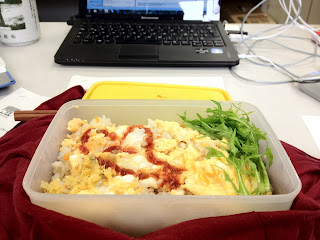
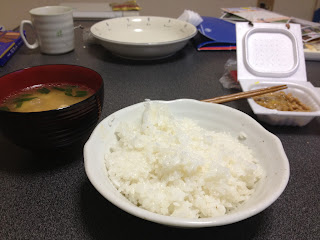
When ever I bring my own, simple cooked meal to Uni that may has some green and reddish colour in it (so a different colour from white rice) male students in the Lab ask me if my girlfriend has made that for me. The first time when a student asked that to me I looked up on him, not sure if he really can't imagine me cooking, or whether he wants to insult me. I answered to him that of course I have done that by myslef and the reactions are often the quite the same: surprise! Apparently, young male Japanese who are able to cook or at least cook their own meals are a rare species in Japan. Close to my desk sit two Japanese students, both male: one is cooking sometimes simple meals for himself, which I consider as cooking (definitely, compared to my simple daily cuisine), but sometimes he will buy already prepared food in convenient stores. The other guys has not even a fridge in his place and no one lives in the city who would cook a daily meal for him, so he is regularly going in to the campus refectory (for lunch and dinner) and his breakfast lays every morning ready in the convenient store on his way to Uni. He says about himself that he can not cook at all, so he might be a rather extreme example of a not-cooking Japanese student.

However, girls on the other hand are often seen with their own "Obento", a lunch box prepared at home. Girls I have talked to are normally showing off with their skills of cooking and baking, blogging and posting pictures and often thinking about the next meal. The latter point is quite often seen among Japanese - even right after lunch the mind wanders to the next meal - dinner and which delicious combinations of ingredients could be arranged. Something I never experience in any other country. Japanese love food and they live it; but more about this an other time.

The reason for this imbalance in cooking skills among male and female student may lay in the way Japanese are raised. It appears to me that many families don't educate young guys in the preparation of food, especially if one of the children is a daughter. Girls often need to help her mother preparing dinner or lunch and learn how to cook in that way while guys get literally spoiled.

The conservative gender-based roles of man and women occur to me sometimes in my daily life: for instance did I pick up the dirty dishes after breakfast in my girl friends house while her grandma was just stepping by. My girlfriend was still sitting at the table, dreaming and still a bit tired, and it was for me the most natural thing to stand up, clean the table and wash the dishes especially since she had prepared the meal. Her grandma saw it and said to her that "it is opposite!", which basically means she expected her to stand up and wash the dishes while I keep sitting at the table.

So far I have not heard of a husband cooking (in a daily base) for it's family, where as in Germany the husband is quite often preparing dinner, or lunch at the weekends.  Even though Germany has no complete gender-biased free working system is it quite usual for both parents to work. In Japan it is usual for a girl to quite her job after three to seven year of working, stay at home and raise the children - Europe, 40 years ago. I don't want to discuss about whether it is good for the kids when the mother stays at home or not; but I just want to point out, that in the Japanese society and under the current family system a Japanese boy is not required to be able to cook or to know how to have his own household (so far everyone is wearing clean cloth!!). The mother gave it to their sons and sons will look for girls who may cook for them later, which will lead to an continuous chain. During the BBQ Party in Hyogo the male guests introduced their wifes with the word "家内" (Kanai), which basically means literally housewife. My young friends who were with me at the party whispered to me that this is nowadays a rude way to introduce your wife, but for the older generations which mean the generation of my own parents it seemed to be quite normal and socially expectable. Apparently young people start to think differently and noticing the gender discrimination more. Hopefully a process that started in Europe and America with the generation of my parents is now going to happen in Japan with the current generation of students!

As I mentioned above: complete meals and "Obentou" boxes can be already purchased in the supermarket, so everything you need to to is walking into an convenient store and choose an Obentou between 350 to 800 or more Yen with things in it you like. Often a bit of rice, varieties of vegetables, and some meat or fish. These boxes are indeed really convenient of you need a healthy, well balanced lunch box.

However, there are some guys I know who can cook and the reason why they eat every day in University cafeteria may lay in their laziness or some where else. For me it was just surprise what some people expected (from me) and what their image of a "guy" is.
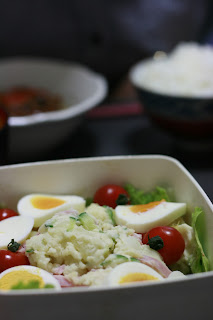
One of the birthday dishes my girlfriend prepared for me.

A surprise Bentou box from Machi!

One of my simple meals (deluxe edition - since it has a Miso-soupe included) (^.~)

Friday, 4 May 2012

Taking a Rest in Hidaka

our ride to Joes house!

It was finally Thursday morning when I woke up at 6 and left my house at around 7 to bike with Machis bicycle that she had left at my place to the train station where I met Machi and Noriko half an hour later.
We were invited from Joe, a friend of us, to stay in his families house for one night in the mountainous area of the state Hyogo. Hyogo is north-east of Okayama and you have to cross it on your way to Osaka or Kobe. I have never been at another place then Himeji, where an old castle watches over the city, and was really looking forward to spend two quite days in the country side with three wonderful friends. We arrived before 11 and helped the family to get everything ready for little feast Joes family was going to give for some of their friends. We were amazed how huge the property of the family was. Joes Dad bought the old house about ten years ago. At that time it was pretty wore down and broken and he spent much time and money into it to rebuild and modernise it step by step. Joe gave us a tour around and it was just impossible not to get lost with all those rooms and gang ways.

With Noriko and Machi on the Way to Hyogo - while both wee talking in the front I enjoyed a small pick-nick in the back (^.^)
2nd floor of the house! Joe gave us a tour around.
This is the old emblem of the former family, a たじばな (Tajibana)
Outer-Inner gang way. Traditionally are the room in the centre of the house and a gang way leads around the house, whereas the gang way in European houses often connects rooms in the centre of the house.
Friday morning and the girls are still in bed, while Joe prepared breakfast!
Lock of the front door!
Old Japanese way to drain the rain down from the roof. Who wants a pipe when you can drip-drop the water down in that way?!
We took lunch under the maple trees in the garden. Joe and his brother had planted these trees about 10 years ago from little plants they took from the forest in the mountains. I tried to imagine how inflamed the garden must look like in autumn! Joe and his brother made BBQ, while we and the other guests sat at the table, enjoyed the delicious food and talked with each other while drinking a glass of wine. Vernon from California and an artist couple were besides Machi and Noriko my main conversation partners. I was amazed that Vernon, who must have been above 80, came to Japan when he was 23 (like me when I came first here). The difference is that he came as American soldier in 1952 and just stayed here since that time! He saw Kyoto and Osaka and all other cities grew up and Japan rise from ashes to what it is now. While listening to his stories I was wondering if I might be one day like him - sitting in a garden somewhere in Japan and talking about my past 60 years that I have spent in this country...
The artist couple sat right next to me and I enjoyed their natural and joyful atmosphere. Besides this, I was astonished that he could drink more than 5 glasses of wine without getting drunk - it's rather rare to see that in Japan. They both invited us to their gallery for the next day. After the cleaning, cake, sweets, tea and saying farewell to the guests, Joe, Noriko, Machi and I finally left to something I was looking all the time forward to as well.

From left to right: Noriko, Joe, and Machi

Kanpai (かんぱい) and thank you for the party family Bito
We drove to a close city, which is famous for Onsen (hot spring) and wanted to take a long bath. I really do love Onsen and probably have spoken already a lot about this kind of the Japanese culture: you basically get naked and man and woman go in separated areas in a pool of hot groundwater! It was golden week and so many people stayed in the traditional hotels in the village, spending their time with shopping, hiking and taking hot bathes in the evening. We found an old style Onsen and I negotiated hard with Noriko to let me at least take a bath for one hour. That was definitive enough to get completely soak in the water which was pretty salty.

The Onsen we have chosen!
Relaxed, tired and after one ice cream did we drive home and played a bit of cards before sneaking into our futons. Machi really wanted to talk with us, while laying in the beds, since the whole scenery had something of camping: rain was falling outside and knocked at the window and roof; no one was around except us four in this big and dark house. But Joe and I just did lay there with our eyes closed and Noriko gave in soon as well so that Machi gave up and fell asleep.
The next morning we only had a quick breakfast and coffee before driving to a stork conservation area close to the place where we stayed. Besides storks you could also see all kinds of insects and other animals of the area.

Part of the butterfly collection you could see in the museum.

Machi was quite amazed by those bugs (~.~)
From there we brought Joe back to the "real" house of the family, where he grew up and drove to the gallery of the artist couple. He already expected us and two other visitors where also guests in the cute wooden house. I liked the place immediately. Carved wood and pieces of art everywhere. A homey atmosphere and a fire burning in the chimney. We were invited for lunch which was really delicious (Machi was wondering before where we could eat something before we drive back to Okayama). I told him that I'm looking since two years for a place where I can buy a hand carved wooden rice bowl, as I would like to have one for my daily meals. He gave me an address of an artist he knows in Okayama where Noriko, Machi and I definitely want to go before this summer!


Noriko and Machi enjoy the chimney in the house of the artist couple!

Monday, 30 April 2012

Green Shower Dragon Forest

"龍ノ口クリーンシャワーの森" -
"Entrance  to the Dragon green shower forest"
The upcoming week is called "golden Week" and marks a couple of days off for most Japanese. So is Monday, Tuesday and Friday public holiday, and many Japanese enjoy also Tuesday and Wednesday off. Families are travelling around Japan and for most of the freshmen it will be the first free time since the beginning of their work. Also for me! Unfortunately, Machi had to work a lot this weekend but since her Mum and Moe (her little sister) wanted to go hiking with the families dog I decided to use the wonderful summer weather in Okayama and joined them.Sunshine and 26°C.
We wanted to get up into the Dragon forest of the green shower. Sten and I spotted the sign already on the way to Yuba Onsen, where we went with Thomas to initiate him into the mystery's of Japanese hot springs. I was very happy to get out of our lab into a Japanese forest: I got the feeling that most forests around Okayama are rather natural finished and enjoyed their earthy smell and dense green.
Meru, the dog of family Hidaka.
One thing I couldn't remember when I came back to Germany after my exchange year in Japan were detailed memories of birds or the vegetation of Japan. Therefore, I decided to pay more attention this time and to learn about the animals and plants of Okayama, Chuukoku and Japan. I started already with some Ornithology, such as the Japanese bush warbler, with it's remarkable song. I get to hear it's melody whenever someone sends me an email or sms on my phone (Go head and make me memorise it's song with an email of yours). However, so I tried to pay attention to the lower and higher plants in the forest, the bird sounds and the animals. I didn't expect a wild boar, bear or deer to appear so I tried to spot some lizards and snakes.
Shrine on the a pre-peak of the hill, view south towards Okayama
I was lucky though, since Moe and I spotted a golden-brown, about 59 cm long, snake slithering away into some brick-wood just a couple of meters a way from us. As far as I know there are no venomous snakes in Japan, but a couple of signs on the way down warning hikers to be aware of "vipers", which are normally considered to be venomous, made me less confident about my vague knowledge.
I think you can call it a cultural difference between Japan and Germany, that you can find in natural spots smaller or bigger shrines, often connected to the local goddess (Kami - 神), and hence connected to Shintoism, not Buddhism. I know that you can find crosses and little chapels along hiking ways in especially catholic areas in Germany (like...let me think... Bavaria, perhaps?), but since Shintoism is not at all related to Christianity it is quite a bit of a difference and the little shrines also look different compared to the chapels ins Bavaria. 
Moe with Meru.
Meru enjoyed the walk up to the about 210 m high peak a lot. She was mostly tied to her line, since she used to freak out when she sees other people coming. It's not that she is going to attack them, but she starts barking and is scared, or excited, we don't really now - a timid little thing. I build up the theory that she sees us as her sheep she needs to protected and just tries to warn strangers not to come any closer to her little babies. We took a short rest at the peak of the hill and enjoyed the view down towards Okayama and into the valley that leads you to Tokushima. We ate self made Onigiri (お握り). Onigiri are made often from left over rice, some stuff inside (like a sour plum, or sesame) and a dried algae "leave" wrapped around it.
View towards west from the peak.


GPS treaking with iphone and google earth back to the car.


Entrance to the Hajiman temple


"Hikers everywhere!"
Thomas showed my how to use my iphone to track myself and record my walked path in GPS coordinates. I tried this for our way down the hill and imported the data into google earth that gave a height and speed profile of our uphill tour. On our way down we stopped on a cross road that would lead us down to the parking lots or to a little shrine on a minor peak, but no direct path down to the hills foot from the shrine was marked on the public map next to the road. However, our own map showed us a path that seems to lead us down to where we started our tour. We gave it a try and walked towards the temple along a small steep path with rough stairs and little stone gates. When we reached the stairs of the Hajiman temple, the goddess of war (that's maybe the reason why the forest is related to a Dragon - I still haven't found out why it is called like that), I realised that the natural granite stones were covered with concrete, a material that gets apparently highly appreciated by Japanese. I couldn't really understand why some one would do something so ugly, but maybe because Granite gets slippery after rain they wanted to increase the friction, or maybe beauty is in the eye of the beholder! At the top of the stairs waited two stone figure, both symbolising dogs, the so called Komainu (狛犬) which are there to prevent evil spirits to enter the inner shrine. One stone figure has it's mouth closed while the other one has it's mouth open. This symbolises the beginning and the end, as they form with their mouth the words "A" and "UN" (mouth closed) which is the first and last letter of the Japanese alphabet (あ and ん). However, even in Buddhism and Hinduism is this sound often used in meditation and represents a similar meaning as the alpha and omega in Christianity. Keisuke from our Lab helped me to find out about the meaning of the dogs, so thanks to him!
As I mentioned above did we try to take the not mapped path down back to the car. Since Meru isn't really used to climb stairs we got a bit into trouble when we discovered that the path led us to a stony steep slope. I hope that only the first meters would be like that but we discovered soon that we could risk to walk that way, since one of us had to carry the dog and climb at the same time.
Stairs up to the temple.
So we turned around, walked back to the temple and down to the cross road where we once began our walk up to the temple.
You meet these kind of dogs quite
often at Shintou temples.
This way down was much more comfortable than the other one (you can see our turning point on the google maps picture) and we even risked it to let Meru walked without her line. She was quite happy to jump around and play with us all the way. When we reached the car, all of us were surprisingly exhausted, even though the hill wasn't that high. Meru fell asleep after a short while. I assume we all were just not used to hike any more. It's been a while since Australia that I moved a lot. I'm happy to ride a good and fast bike again, but I'm still not back in form, when I ever have been in "form" before! I definitely want to do something like that twice or three times a week. Work a lot in the week and enjoy the weekends outside. There are still many little things I haven't discovered around and in Okayama. Hopefully I can present some of those things here in the year I'll be around in this city. On Thursday and Friday we are going to a trip to a friends house in Hyogo-ken. Hopefully, I find sometime to write about it next weekend.

All the Best,

Your Ray

Pre-Peak of 龍の森

Entrance to the rocky path - it looks harmless here, but only because it is the entrance. We decided to return - probably fun to get up this way.

Monday, 23 April 2012

Geocaching in Okayama

It's been just a month since I've left Germany and started to settle again in Okayama. One of my favourite games whenever I wanted take a rest from work or just went outside for a walk with Machi was to find small hidden objects, so called geocaches, as you might remember from my previous posts from Australia.

This game is not very popular in Japan, at least not in Okayama. They're some caches around Tokyo and Osaka and even one in Saidaiji, but only one in Okayama and a couple around it. Nothing is hidden in a walk-able distance. So one of my hobbies now is to hide caches in places I like to stay in Okayama. So far Handayama and the University is marked as well as the Dojo where I try to shoot as often as I can, which isn't much recently. However, it's quite fun to hide them and to think about new locations. Two of them are traditional caches, but I don't really want to make so many traditionals. The one at Uni is a mystery cache, my first one, but so far no one has found it. I hope to get the game a bit popular while I'm staying in Okayama.

Thomas, a good friend from America stays at the moment with me. Japan is his first place ion a long journey around the northern hemisphere. He might be in Germany in June.

Korean food with (left) Yuki, Johannes, Thomas, Stefanie and me.

With Thomas and Sten out for Sushi!

Thats Purikura - get your eyes bigger and some extre make-up! I look even more like a girl because of the automatic Photoshop software! But it's a good souvenir for Thomas.